
The Arnolfini Portrait by Jan van Eyck
Why is opinion still divided about this 600 year-old artwork?
This famous painting, created in 1434 in Bruges, Belgium, by the Netherlandish painter Jan van Eyck, has been controversial since art historians first attempted to describe it. It appears mysterious, with contrasting elements that do not seem to fit well together.
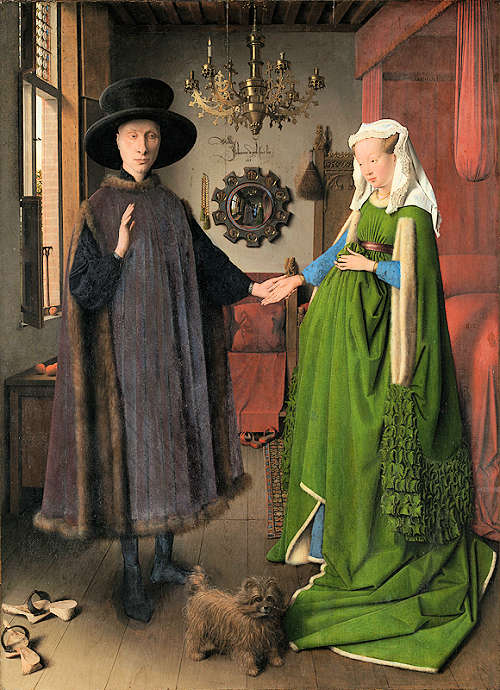
One obvious clue as to the purpose of the painting is signified by the large hat worn by the man. A man would not wear his hat in another man's house out of respect, so this is his residence. The hat lets us know that he is the most important person in the picture and in charge. We should, at the very least, pay careful attention to the emotional expression on his face.
The painting is divided into left and right sides. On the left, a lit candle in the chandelier nearest the man is a traditional symbol that he is alive in the present. On the right, the candle in the chandelier nearest the woman is out, a traditional symbol that she is deceased. Since she is shown as life-like, she can only be a memory of when she was alive.
The emotional expression of the man's face is solemn grief and sorrow. He is looking straight ahead, not at his late wife as we see her in the painting, because she is present only in memory.
His left hand extends across the center into the right side, holding hers. Her hand is open, palm up, and passive, not clasping his. Their hands symbolize him holding onto her memory as a beloved wife devoted to her husband.
His right hand does not have his palm facing where he is looking, as is customary when greeting someone, but to his left, to greet his late wife in memory.
His wife is shown facing him, dressed in bright colors, as he wanted to remember her in life. This is not a portrait of her in death.
Every aspect of the painting presents the man as very wealthy. It is also filled with items involving life, on the left side, which are absent on the right. The open window lets in daylight, providing visibility and fresh air. A cherry tree outside the window bears cherries, which are food and symbolize love. The oranges, to be eaten, were rare and expensive for the period. The pattens, or clogs, worn on shoes to protect them from the grime of the streets, are something that would only concern the living. Her pattens are in the center back, not with her, and can be interpreted as having been removed some time ago.
This painting is known for its exquisite detail by a painter of exceptional skill. The mirror in the center depicts two people witnessing the occasion. It is uncertain if one is the painter, who signed his name in Latin as "Jan van Eyck was here" above the mirror, identifying himself as a possible unseen third witness. The ten small round pictures surrounding the central mirror depict scenes from the passion of Christ. The four pictures on the left show Christ in life. The four on the right, the woman's side, show scenes after his death, again suggesting she is deceased and a memory.
The little dog, signifying fidelity, seems to have been put in last, and slightly breaks the separation of left and right sides. An expensive and rare breed of lapdog, its head is nearest the woman, suggesting that it was a gift to her from her husband.
Certain features of this painting have caused it to be interpreted as a marriage or betrothal. The overall appearance is that of a formal ceremony in a private residence. Some ceremonies require witnesses, and the painter's signature and the images in the mirror provide that. But the central question then becomes why would a wealthy man show himself in sorrow, grieving, and not looking at his wife? The most likely reason is that this is the one year anniversary of his wife's death, and this painting displays a one year anniversary mourning ceremony in front of witnesses; a custom observed in various forms across parts of Europe at the time.
Our conclusion must be that it is important to know the traditions of the country and time period in which a painting was made. Without that cultural knowledge, there is a risk of misinterpreting the painting altogether. Overall, the symbolism and masterful detail in this painting are so rich that it seems to have easily lent itself to many distracted discussions that never arrive at the painting's true purpose.
Dennis Evans
© 2023-2026 by Topicnews.org
Questions or comments? Email info@TopicNews.org