

New Discoveries About the Great Pyramid of Giza
Were the ancient Egyptians more advanced than we know?
The Great pyramid of Giza was built 4,600 years ago. It was preceded by 180 years of cut stone pyramid construction involving trial and error.
The first monumental stone pyramid was built in 2780 BCE at Sakkara by king Djoser. A step pyramid with six terraces, it was the first cut-stone burial monument. Two other pyramids were started later but abandoned due to the early death of their kings.
Three more pyramids were completed between 2612-2589 BCE during the reign of Sneferu. The Meidum pyramid, initially a step pyramid, was later modified to be smooth-sided. It suffered a partial collapse, probably during construction, when the outer walls fell off the inner structure. The Bent pyramid has a lower slope of 54.5-55° and an upper slope of 43°, a change thought to be a response to the collapse of the Meidum pyramid. The Red pyramid, built of red limestone, also has a 43° slope. It was the first geometrically true, smooth-sided pyramid, and is the third-largest in Egypt.
Sneferu's son Khufu built the Great pyramid of Giza, primarily using limestone, completing it about 2600 BCE. With a 51.84° slope, it is the largest pyramid in Egypt. While experience gained from Sneferu's three pyramids informed the development of the Great pyramid, it has unique design elements found nowhere else. Archaeologists have studied it for centuries to determine its internal structure and the construction techniques employed.
One of the unique features of the Great pyramid are the "stress relieving chambers" above the King's chamber. The entire King's chamber is composed of red granite blocks, including flat ceiling slabs with a 17.2' (5.2m) span. To eliminate weight on the ceiling slabs, which would cause them to break, a series of four other red granite ceilings, rough-hewn, are stacked above, separated by air gaps. A gabled limestone roof, shaped like an inverted "V", sits above all of them, directing overhead weight to the sides of the chamber.
Structurally, the four additional red granite roofs are not needed between the flat chamber ceiling roof and the gabled limestone roof. But recently, it has been discovered that the relieving chambers reduce vibrations within the pyramid that originate outside.
Red granite symbolized eternity, divine power, and the life-giving energy of the sun to the ancient Egyptians. It is also denser, heavier, and harder that limestone. Because of these features, the construction of the relieving chamber complex results in a different resonance frequency than the sections of pyramid below and above it. This causes it to serve as a vibration damper.
We cannot be sure of what the Egyptians knew when they built the relieving chambers. But the relieving chamber complex does serve to reduce the susceptibility of the pyramid to Egypt's infrequent earthquakes. This may be part of the reason why the Great pyramid is still largely intact after 4,600 years.
The grand gallery is another feature found in no other pyramid. While its two-sided corbelled ceiling is present in earlier pyramids, the length and size of the gallery are unique. It may have been multi-functional. It was possibly involved in funeral rites after Khufu's death. It could then have been equipped with wooden shelves on both sides, and filled with containers of the king's belongings, waiting to be taken and arranged inside the burial chamber. Finally, the location of temporary storage for the ascending corridor blocking stones, and the manner of their release, are unresolved issues. The gallery may have been involved in all of these.
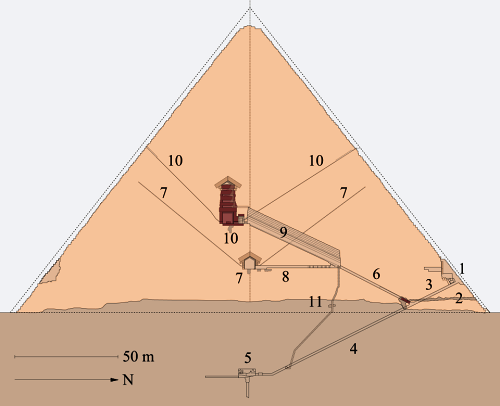
4. Descending tunnel 5. Lower chamber (unfinished) 6. Ascending corridor
7. "Queen's" chamber and relative ventilation ducts (likely a serdab)
8. Horizontal corridor 9. Grand gallery
10. King's chamber with relieving chambers above and relative ventilation ducts
11. Vertical tunnel allowing last workers to escape after ascending corridor was sealed
The design of the ramps that were used to construct the Great pyramid has long been in dispute. What we do know is that about 2.3 million stone blocks were used to build the 210 terrace-high (including capstone) pyramid in the 27 year reign of Khufu. That many stones could be assembled in only 20-27 years if a stone was placed every three minutes during daylight hours, allowing for severe weather interruptions. This would necessitate four ramps at the bottom instead of one, then three ramps higher up where fewer stones we needed, then two ramps even higher, then one near the top.
A recent mathematical model for integrated edge ramps has been developed which is compelling. See A Computational Framework ... which includes video animations. These ramps initially replaced some of the outer edge stones with small stones to build 7.4 degree ramps spiraling upward across the outside edges of the pyramid during construction.
Once the top of the pyramid was complete, workers would erase the ramps from the top down as the pyramid was finished, by replacing the small ramp stones with large stones designed to be in the final pyramid.
The massive scale and unique architecture of the Great pyramid reveal the most important skills the ancient Egyptians possessed during the Forth Dynasty: the ability to design complex construction projects in sequential steps; to create and manage a large bureaucracy keeping track of what to get done when; and to supervise massive numbers of people working on a variety of coordinated tasks. To a certain extent, the entire Egyptian economy and society were geared toward pyramid construction.
Dennis Evans
© 2023-2026 by Topicnews.org
Questions or comments? Email info@TopicNews.org